 E-mail: sales1@rlbcable.com
 English
 العربية
 Le français





What Is a Cable Extrusion Machine and How Does It Work
 Oct 21, 2026|
 View:6
A cable extrusion machine melts raw materials like PVC or XLPE and shapes them into insulation or jacketing around a conductor. The machine coats metal conductors with a plastic or rubber layer to make cables that last and perform well. Demand for this equipment keeps rising; one market article predicts a 5.8% compound annual growth rate for the cable extrusion machines market through 2033. This article explains the cable extrusion process, the key parts of a cable extruder, the main machine types, and the factors that guide equipment selection. Readers who understand each stage of cable extrusion can judge how a wire and cable extrusion machine fits a given production line. The sections ahead also show where a cable extruder machine gives the most value.
Key Takeaways
A cable extrusion machine melts plastic and shapes it around a wire to make insulation or a jacket.
The extrusion process has six steps: prepare the wire, melt the plastic, shape it, cool it, check the size, and coil the cable.
The screw and barrel are the heart of the machine. They melt and mix the plastic.
Single-screw extruders are simple and good for standard jobs. Twin-screw extruders mix materials better and produce more output.
Choose a machine based on the material, screw size, line speed, and output you need.
How Cable Extrusion Works
The Cable Extrusion Process
The cable extrusion process follows a set order, and each step builds on the one before it.
Conductor preparation – bare wires enter the line, where they are cleaned and straightened.
Material feeding and melting – polymer pellets drop into the extruder, and the screw melts and mixes them until they are even.
Extrusion and shaping – the melted compound is pushed through a die, which forms an insulation or sheath layer at a set thickness.
Cooling and solidification – the coated cable passes through water troughs, which set the insulation and keep the size exact.
Diameter control and monitoring – laser gauges check cable diameter nonstop, and the line adjusts itself to keep quality steady.
Cutting and coiling – the finished cable is cut to length and coiled.
The heating stage shapes the whole cable extrusion process. For PVC, a flat temperature profile between 170–190°C helps avoid thermal degradation. Heating history also changes how the material acts later, so steady temperature control protects insulation quality during the cable extrusion process. A clean die and steady heat keep the cable extrusion process stable.
Conductor Coating to Coiling
A cable extrusion machine coats a moving conductor without stopping. Wire extrusion starts at the payoff, which feeds bare copper or aluminum. Tension brakes or dancer accumulators hold steady tension to prevent stretching. Resin pellets pass through a cooled hopper into the extruder. The screw melts and mixes the polymer, then pushes it through the die inside the crosshead. That die controls coating thickness and sets the layer as the wire exits into a water bath. The cable extrusion process rewards steady tension.
Cooling decides much of the final quality in the cable extrusion process. Uneven cooling can distort the coating shape or size, and internal stresses can weaken the cable over time. Direct water immersion moves heat away efficiently, while indirect cooling through a water jacket prevents contamination and gives better control. Cooling efficiency depends on line speed, coat weight, and material properties. A chilled multi-stage trough and an air wipe complete the set. Operators watch the cable extrusion process closely at this point.
The cable extrusion process then moves to pulling and inspection. A capstan pulls the cable at a controlled speed, adjusted by laser diameter control. Laser micrometers confirm the result and adjust capstan speed as needed. Wire extrusion ends at the take-up coiler, which winds the product for storage and shipment.
Continuous wire coating brings real property benefits. The polymer layer improves oil and fluid resistance and raises stress crack resistance, so the cable holds up in harsh service. Good wire coating also depends on a clean die and steady heat. Every stage of the cable extrusion process, from feeding to coiling, shapes those properties. Wire and cable extrusion rewards tight control of insulation thickness. A well-run cable extrusion process turns raw compound into a durable product for cable manufacturing and cable production. Buyers who match machine settings to the product get the most from each run.
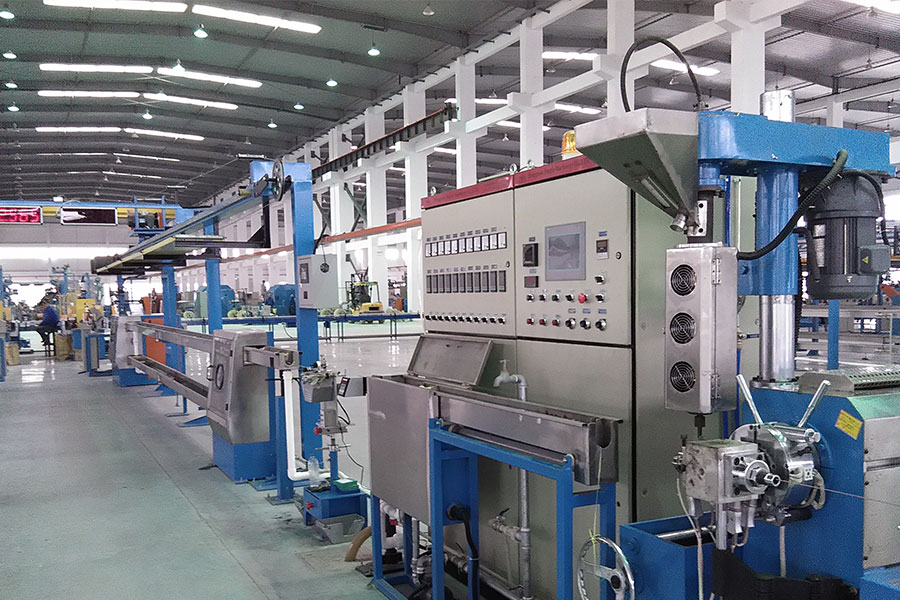
Key Components of a Cable Extrusion Machine
The Screw and Barrel
The screw and barrel are the heart of every cable extruder. The barrel is the fixed outer shell that creates a hot, pressurized space. The screw turns inside it and pushes raw plastic forward. Heat from friction between the screw, barrel, and material melts the plastic. Screw design and barrel temperature control work together to ensure even melting and mixing for consistent product quality. In wire and cable extrusion, these parts form insulating and protective layers around conductors. They also hold coating thickness and dielectric properties steady.
The screw does three jobs in three zones: melting, mixing, and moving material. The feed section has deep channels that pull in solid pellets from the hopper. The transition section gets shallower and squeezes material against the hot barrel wall, where most melting happens. The metering section finishes melting, evens out the melt, and pumps it at steady pressure to the die.
Screw geometry matters as much as screw function. The L/D ratio (length divided by diameter) shows overall length and processing capacity. It is different from the compression ratio (feed depth divided by metering depth), which shows channel squeezing and shear heat. Both must be set correctly, and they are not interchangeable.
Aspect | Effect of L/D ratio |
|---|---|
Blending and plasticization | Higher L/D improves polymer blending through longer residence time |
Throughput | Higher L/D allows higher rotational speeds at equal quality |
Heat-sensitive polymers | Shorter L/D preferred; longer screws risk thermal degradation |
Typical range | 20:1 to 30:1 as a starting point, not a rigid rule |
A higher L/D does not directly raise output. Output depends more on screw diameter, speed, and metering zone depth. Better melt quality can indirectly allow higher stable output.
Temperature Control and the Crosshead
Precise temperature control in the crosshead directly affects insulation quality through melt-flow behavior. When polymer does not arrive evenly around the full circumference, often from a temperature imbalance, one side of the insulation builds up thicker. This causes eccentricity. Temperature differences across the crosshead change melt viscosity on one side, which again skews wall thickness. Even crosshead temperature is a key lever for achieving concentric, uniform insulation.
The crosshead turns melt ninety degrees so it wraps evenly around the wire. Inside, flow channels split the incoming melt and bring it evenly around the full circumference. The tip sets the inside boundary of the plastic, and the die sets the outside diameter. Concentricity is the key quality measure. An off-center wire makes a thin side with reduced dielectric strength and a thick side that wastes polymer. Good crossheads allow fine centering adjustment so the operator can keep the wire dead-center.
Temperature control methods vary by zone. Cast aluminum heaters, mica band heaters, and ceramic heaters supply heat. Air cooling and liquid cooling remove extra heat when a zone reaches its upper setpoint. Each zone has temperature sensors and a controller that regulates barrel temperature. Small extruders up to 3 in. have three to four zones, and larger ones have six or more. Cable extruders rely on this zone-by-zone regulation to keep the extrusion process stable.
Crosshead dies with adjustable mandrel and die gap enable precise control of insulation wall thickness and concentricity. For high-speed applications, dies with extended land lengths and optimized convergence angles provide improved melt flow stability and reduced pressure fluctuations that can cause surface defects.
Surface roughness often comes from melt temperature too low or a crosshead not up to processing temperature. Carbon or degraded material points to stagnation zones or material left during shutdown. Thorough purging before shutdown and regular crosshead cleaning prevent these faults. The extrusion process rewards steady heat and clean flow paths. Every cable extrusion machine depends on these two components working together. Diameter control and monitoring then confirm that the cable diameter stays within tolerance throughout the run.
Types of Cable Extrusion Machines
Single-Screw vs. Twin-Screw Extruders
Single-screw and twin-screw cable extruders do different jobs in cable extrusion. A single-screw cable extrusion machine melts and pumps a mix that is already prepared, so it works well for insulation and jacketing. A wire and cable extrusion machine often uses this design. Twin-screw cable extruders are best at mixing and blending multi-component cable materials. Cable extrusion of PVC compounds also works well with counter-rotating twins, because low shear and high pressure control stop degradation. Twin-screw designs add self-cleaning screws and modular barrels, and these features cut color-change time and help with devolatilization. A cable extruder machine for wire extrusion must hold tight tolerances.
Feature | Single-Screw | Twin-Screw |
|---|---|---|
Mixing | Moderate | High |
Initial cost | Lower | Higher |
Operational complexity | Simple | Complex |
At the same screw diameter and speed, a twin-screw unit reaches about three times the theoretical output of a single-screw unit. Twin-screw capacity spans about 75–7,000 kg/h, and single-screw capacity ranges about 10–2,000 kg/h. Both types are still central to modern cable extrusion, and each one fits a defined job.
Multi-Line Cable Extrusion Lines
A multi-line cable extrusion line runs several conductors at once, and this setup lifts throughput for high-volume cable extrusion. One cable extrusion line can combine insulation and sheath layers in a single pass. Reported gains include production efficiency up more than 40% and raw material waste down 6%–10%. Changeover can finish within 15 minutes, so a plant can switch products with little lost time.
The cable extrusion process on these lines stays stable, because fixed dies and tight control of temperature, pressure, and line speed produce uniform cross-sections. Co-extrusion lets several extruders feed one die, so a multi-layer cable comes out in one pass. A wire extruding machine on such a line still needs steady tension and clean dies. Buyers should match the wire and cable extruder to the product mix and output targets. The extrusion process rewards steady heat and clean flow paths. Wire and cable extrusion depends on this balance. Cable extrusion lines reward careful planning, and every cable extrusion run needs a clean die. A stable extrusion process keeps wall thickness on target.
Wire and Cable Extrusion Applications
Where Cable Extrusion Is Used
Cable extrusion makes many kinds of products. Power cables are one big group. Low voltage cables and medium, high, and extra-high voltage cables all use extrusion for insulation and sheathing. Building wire and automotive cable work the same way. Coaxial, LAN, and telecom cable also depend on this method. Fiber optic, rubber, and special cables complete the list. One supplier says foaming agents show up in aerospace wire, automotive wire, power cables, and building wire extrusion. Communication cable adds its own set: coaxial and composite cable, video pair cable, CATV cable, and aerial cable. Every product uses wire coating to protect the conductor and carry the signal or current.
The cable extrusion process does two main jobs. Insulation keeps the conductor apart from its surroundings and controls electrical performance. A sheath or jacket adds mechanical and environmental protection. Multi-layer cable extrusion line setups do both jobs in one pass. Heavy-duty lines handle LT and HT power cable insulation with single, dual, or triple layers. This range shows how central cable extrusion is to cable manufacturing and cable production.
Selection Factors to Consider
Material type drives most decisions. PVC, XLPE, rubber, LSZH, and TPE each act differently in the barrel. PVC runs at about 170°C to 190°C, while FEP needs 300°C to 360°C. A machine that cannot hold 350°C within ±5°C will struggle with high-temperature insulation materials. Screw diameter follows the output target. Fine wire insulation often uses about 30 mm, and heavy cable jacketing uses 150 mm and above. Line speed and output requirements must match the product mix. Insulation work needs tight control of insulation thickness and cable diameter, while jacketing favors higher output and longer cooling.
Factor | What to Check |
|---|---|
Material | Screw, barrel, and heating must suit the compound |
Screw diameter | Sized from output, which equals line speed times covering weight |
Line speed | Must hold tolerance at the real working speed |
Output | Should fit the product range and stability needs |
Buyers should compare the full cable list with the machine maker before ordering. A cable extrusion machine that holds tight thickness and diameter at the actual running speed gives more value than a faster unit that drifts. Matching the wire extrusion setup to the material set and tolerance budget keeps cable manufacturing efficient.
A cable extrusion machine melts plastic pellets, pushes the melted plastic through a die, cools the new layer, and coils the finished cable. Every cable extrusion run follows that same order: feeding, melting, shaping, cooling, and coiling. Steady heat and a clean die keep the cable extrusion process stable.
The body covered the screw and barrel, temperature control, and the crosshead. It compared single-screw and twin-screw extruders and multi-line cable extrusion lines. The type of material, screw diameter, line speed, and output all shape the choice. Good cable extrusion matches insulation needs and tolerance budgets. Buyers should pair machine type and specifications with the product and production targets. Careful cable extrusion planning pays off.
FAQ
What does a cable extrusion machine do?
A cable extrusion machine melts plastic pellets and pushes them through a die. The die shapes a plastic layer around a moving conductor. The cable then cools and coils. This cable extrusion step protects the conductor and carries current or signal. An extrusion line runs this cycle without stopping.
Which materials can a cable extrusion line process?
Most lines run PVC, XLPE, rubber, and LSZH. PVC processes at about 170–190°C. High-temperature materials need a barrel and heaters rated well above that range. The extrusion setup must match the compound. Material choice drives most decisions in cable extrusion.
What is the difference between single-screw and twin-screw extrusion?
A single-screw extruder melts and pumps prepared compound. A twin-screw unit mixes multi-component materials better and reaches about three times the theoretical output at equal diameter and speed. Each design fits a defined job. Both remain central to cable extrusion for a given cable product.
Why does temperature control matter in the extrusion process?
Even heat keeps melt viscosity stable around the crosshead. Temperature imbalance skews wall thickness and causes eccentricity. Steady zone control protects insulation quality during the cable extrusion process. A clean die and steady heat keep cable quality on target.
How does a buyer choose the right cable extrusion setup?
Buyers check material type, screw diameter, line speed, and output. Fine wire work often uses about 30 mm screws, and heavy jacketing uses 150 mm and above. A stable extrusion process at the real running speed matters more than peak speed. Careful cable extrusion planning pays off.
I want to comment



Recent News
1.How to Build a Connected Wire & Cable Production Line Without Downtime: From Bunching to Extrusion
2026-10-142.How a Smart Cable Extrusion Machine Boosts Insulation Quality and Line Speed
2026-08-043.IEC 60502-2 Extrusion grade XLPE compound for power cables
2026-06-154.Three-layer Co-extrusion Dry-cure CCV Production Line
2023-02-165.Insulation and Sheathing Extrusion Production Line
2023-12-136.Cable Three-layer Co Extrusion Sulfur Production Line
2023-09-257.Aluminum Sheath Corrugated Pipe Continuous Extrusion Line
2021-11-038.Three-layer Co-extrusion Dry Cross-linking Production Line
2021-12-29





View More(Total0)Comment lists